




Nagawa meets the Red-tailed Monkeys of Bwindi Impenetrable Forest
THUMP!
THUD!
CRASH!
If ever there was a rude awakening, this was definitely it.
It’s early.
It’s been one hell of a journey to get here (a whole day’s public transport from Kasese to Buhoma). The house rat has kept us awake half the night and I need my shut-eye… I turn over and try to get back to sleep.
But it’s not to be.
Above my head it sounds like the gates of hell have burst open!
At any moment I feel the tin roof will give way and whatever’s out there will land right on top of us. I can’t imagine what’s making such a racket.
The noise seems to move from one side of the roof to the other.
“What the hell …?” I shout loudly at Steve above the noise.
The unholy din subsides. They’ve gone.
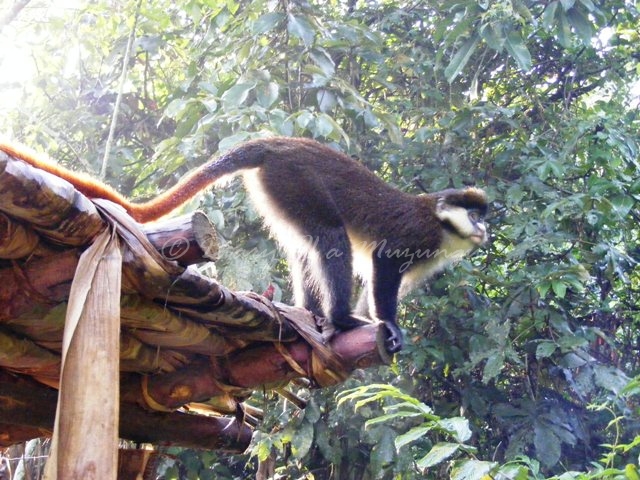
Woken from my deep sleep, I’m not appreciating the hullabaloo created by the family of Red-tailed monkeys – locally known as Nkima – emerging from Bwindi Impenetrable Forest to clamber across Stevie’s little tin-roofed shack in search of their breakfast.

Nagawa’s totem, the gorgeous Red Tailed Monkey, nkima, clan totem of the Buganda Kingdom. Bwindi Impenetrable Forest
There’s a rat in the rafters, what I’m a gonna do… [to coin a popular UB40 song].
Across the field of pineapples, tucked away in a damp corner at the edge of Bwindi Impenetrable Forest, stands my home for the week-end. It’s a typical Ugandan house construction: a coating of plaster covers a wattle and daub box; wooden shutters cover the two paneless windows. There’s no electricity, no running water and the toilet, an earthen pit latrine, is a two minute stumble in the dark from the house.
My first night in Bwindi, mosquito nets tucked in tightly, we take bets on “whose bed the rat will scamper across in the night.” We snuff out the kerosene lamp.
As our laughter subsides, the house comes to life. There’s a definite pitter patter of small rodent feet. It’s getting louder.
“It’s in the rafters above us!” Steve cries. “IT’S COMING OVER!”
The house has two rooms. The wall that separates them only extends two metres high. We’ve attempted to pull the warped wooden door shut to keep the rat out of the bedroom but rats make their own rules. They love height. It will obviously climb over the top. I try not to snigger; I secretly look forward to a rodent encounter.
The morning after
With “the upstairs neighbours’ party over” – but unable to sleep again – I get up to make my morning tea. As I strike a match to light the gas ring, the rat leaps out from its nest inside (yes, inside!) the stove’s metal casing. It’s a WHOPPER!
Tea mug in hand, I wander outside to investigate the bird-like ‘tut tut’ coming from a nearby tree. I twitch, ready to reach for my binoculars.
A blue face peers down at us. He sports a white, heart-shaped patch on his nose. Pure white cheek whispers frame his distinctive features. Seen straight on, the effect is quite alarming.
Resting to feed on some leaves, the Red Tailed Monkey’s sumptuous long copper tail loops suggestively around a branch. He quietly chomps away. His thick tail fur glows russet in the sun’s early rays.

Red-tailed Monkey on roof. Bwindi Forest
“He must like women,” Steve comments. “He’s never let me get this close before,” he says, sounding slightly put out. (I can’t help but smile at my luck for such a close encounter!) Steve has lived a stone’s throw from Bwindi Impenetrable Forest for months. We are fellow VSO volunteers.
Wildlife enthusiasts like me thrill at the chance to get so close to nature. However, my work with the Uganda Conservation Foundation has shown me what a grind it is to deal with noisy, foraging animal behaviour every day. It’s hard to imagine how the average poor Ugandan farmer copes, especially when you have your own family to feed. But, I admit to a real soft spot for these forest guenons.

The early morning sunshine glow of a Red-tailed Monkey in Bwindi Forest

Protecting my totem, morning tea in hand. Nagawa meets Red-tailed Monkey. Bwindi Impenetrable Forest
Nagawa, protector of Nkima, the Red Tailed Monkey

At an exhibition by the artist Taga, I bumped into a Ugandan lady called Nagawa in front of this painting of our totem! Nagawa, enkima clan, protector of the Red-tailed Monkey
“If you stay in Uganda, you must have a Ugandan name,” my tour driver friend Rashid had insisted one day, and so I was named Nagawa, protector of the Nkima (or Enkima) clan. In Buganda culture, each clan is represented by a totem, which can be an animal, bird, fish or plant – even a mushroom! You are not allowed to hunt, eat or kill your totem. I am honoured to have been awarded custody of such a fabulous creature.
Back in Bwindi, our red-tailed observer follows us around the forest clearing as we finish our tea.
The sunlight picks out a spectrum of colours in the grizzled brown fur of his back. The white fur on his belly looks as soft and downy as a baby rabbit’s. I imagine how it might feel to brush my face against it.
Takeaway chicken
A little later, Nkima pauses on the dry banana leaf roof of Steve’s chicken shed, peering beneath his front feet into the empty shed below. (The chicken was carried off by the Safari ants one week-end when Steve had left Buhoma).

Safari ants can be vicious – and put the organisational skills of the average human to shame! As we leaned over them to take photos, the big guy waved at us menacingly. His job is to protect the worker ants
The chicken may have gone but a bag of chickenfeed remains to tempt a hungry monkey. He quickly climbs down the outside of the shed and hops inside to grab a handful of feed before he jumps away across the tin roof of Steve’s house, back to his family group waiting in the larger trees.
Monkey business done for the day, a cold ‘bucket shower’ and a breakfast chapatti beckon the bazungu!
The celebrated Ugandan artist Taga Nuwagaba has dedicated many years to researching and painting Uganda’s totems, in order to preserve their culture and promote conservation.

African Elephant painting by Taga
Visit the Buganda Kingdom web site for more information on clans and totems. (The Baganda are not the only tribe in Uganda to have clan totems, but their system is the most complex and best documented).
This story took place on the edge of Bwindi Impenetrable Forest, south western Uganda. It was my entry into this year’s BBC Wildlife Nature Writer of the Year competition. Alas I was unsuccessful – fingers crossed for another year then!






Your story reflects the real Ugandan safari experience. This is how you should explore this great country!
Indeed, why go to Kenya or S.A. when we have the real wilderness here, minus the busloads of tourists!
Lovely piece.
However, why go to Kenya?
🙁
Kenya is an incredible place too! Work with a knowledgeable local tour operator for the best, up to the minute advice. People read some bad news from one tiny corner of Africa and dismiss the whole continent; it’s a question of educating ourselves.
Kenya is offering tourists some fantastic deals at the moment, e.g. halfprice park entry fees. The national parks are hundreds – thousands – of miles away from the (few) troublespots. The Kenyan economy desperately needs tourist dollars. Don’t stay away from Kenya and Uganda 🙂